Not every dog qualifies. Not every owner is ready. When both are — we build something that cannot be replicated anywhere else.
A protection dog is not a dangerous dog. A protection dog is a precisely controlled dog with a reliable on/off switch, the drive to engage a real threat, and the stability to be a calm, trustworthy family member in every other moment.
At Black Ice, we build that dog by starting where most programs don't: at the foundation. Before any bite work begins, your dog's obedience must be locked. Before any protection is introduced to you, your handling must be solid. This isn't bureaucracy — it's the only way to do this right.
The result is a dog that protects because it has been built to — not because it has never been taught not to. That distinction is everything.
All dogs entering protection training must first demonstrate a solid obedience foundation. Dogs without prior training can complete our Obedience Board & Train program first. We will not begin protection work on an obedience-deficient dog under any circumstances.
Both paths produce a reliable, controlled protection dog. The difference is context and application. We'll recommend the right track based on your dog's temperament and your intended use.
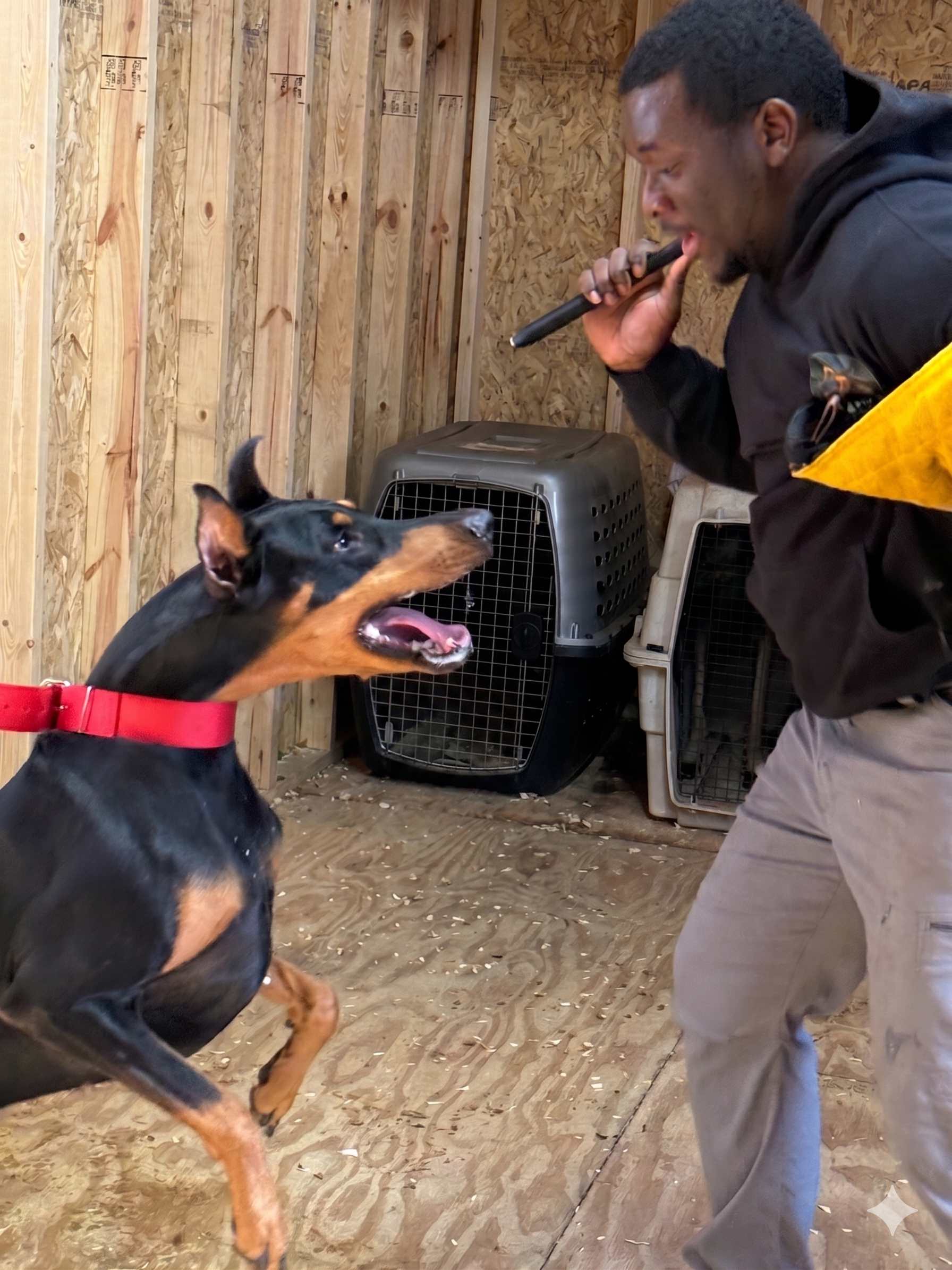
Designed for the owner who wants a personal protection dog capable of functioning in real-world environments — on property, in public, and in the vehicle. Civil work builds a dog that reads genuine threat cues and responds accordingly.
Built for dogs with the drive and structure for PSA, K9 Street League, APPDA, or similar working dog sports. Sport protection develops technical precision, full-mouth grip, and the handler relationship required at competition level.
The most comprehensive path available. Your puppy is raised in our facility from 8–10 weeks, with protection development built in from day one. Imprinting, socialization, obedience, and full protection are delivered as a seamless, unified program. You receive a turnkey protection dog.
Every protection dog — regardless of track — is developed through the same four-phase progression. No phase is skipped. No timeline is rushed.
Full command reliability established or verified before any bite work is introduced. The dog must be flawlessly controllable at this stage.
Channeling the dog's natural prey and civil drive into controlled, structured engagement. Building the foundational bite with correct mechanics from the start.
Formal protection scenarios introduced with a professional decoy. Civil threat responses or sport protection phases developed according to track selection.
The dog is transitioned to you with full handler training, real-world proofing, and ongoing support. Your dog works for you — not just for us.
The most dangerous dog isn't the one with the hardest bite. It's the one with no off switch — and an owner who never learned the difference.
No bite work begins on a dog without a solid obedience foundation. Control before capability — always. A protection dog without obedience is a liability, not an asset.
A properly trained protection dog is one of the safest dogs in any room. Stable, calm, and social until directed otherwise. The switch must work in both directions — every time, without exception.
We build capable dogs. We also build capable owners. A protection dog in the hands of an unprepared handler is dangerous. We hold ourselves responsible for both halves of that equation.
We turn down applications. We decline dogs that don't have the temperament. We decline owners who aren't ready. This isn't arrogance — it's the only ethical way to produce reliable personal protection dogs.
Not every dog — regardless of breed — has what protection work demands. These are the traits we assess at intake. All must be present in sufficient degree before we accept a dog into the program.
The dog must be psychologically stable — confident without being reckless, unfazed by novel stimuli, and capable of recovering quickly from stress. Fear-based dogs do not make protection candidates.
Sustainable, controllable drive — prey, ball, or civil — that can be channeled into structured work. We need fire that can be directed, not a dog that is either switched off or uncontrollable.
The dog must be bonded to and focused on its handler. A protection dog that doesn't respect or work with its owner is not a protection dog — it's a loaded weapon with no safety.
Protection work is physically demanding. We require dogs to be structurally sound, free of significant orthopedic issues, and cleared by a veterinarian before program entry.
Breed alone does not guarantee candidacy. We have declined working-line dogs with the wrong temperament and accepted mixed-breed dogs with exceptional drive and nerve. The evaluation is the only test that matters.
My Malinois went through the civil protection track after completing the board & train. The on/off switch Cedric talks about is real — she's the most calm, social dog at home, and completely locked in when she needs to be. The level of control is unlike anything I expected.
Bought my Rottie for protection—he's confident, obedient, and won't hesitate when needed. Worth every dollar.
I came in with a GSD that had tremendous drive but no structure. Cedric put him through the obedience program first — wouldn't touch protection until it was solid — then built the most reliable personal protection dog I've ever seen. The patience and the standard are second to none.
The questions we hear before every protection enrollment.
We don't accept every dog or every owner. If you believe you and your dog are ready — apply for an evaluation and let us determine next steps together.
Tell us about your dog, your experience as a handler, and what you're looking to accomplish. We review every application and respond personally within 24–48 hours.
All applications are reviewed personally. The more detail you provide, the better we can assess fit before your evaluation appointment.